Maker encyclopedia
Carrier 🇺🇸
Estados Unidos · est. 1915 · Syracuse (N.Y.) since 1937 · United Technologies 1979-2020 · Carrier Global since 2020

Willis Haviland Carrier (Angola, New York, 1876) graduated as an engineer from Cornell in 1901 and began working at Buffalo Forge. In the summer of 1902 he was tasked with solving a humidity problem at the Sackett‑Wilhelms printing house in Brooklyn, where the paper expanded and the color inks did not match: his cooling and dehumidifying system is considered the first modern air conditioner. The patent arrived in January 1906 and in 1911 he presented his “Rational Psychrometric Formulae” to the ASME, the theoretical basis of the entire industry. On June 26, 1915, with World War I in the background, Carrier and six colleagues raised $32,600 to found Carrier Engineering Corporation in Newark (New Jersey).
The twenties were the years of the leap to comfort: in 1922 it introduced the centrifugal cooler; in 1924 the Hudson's department stores in Detroit installed three 195‑ton machines because customers fainted on sale days in the basement; and in 1925 the Rivoli cinema in New York premiered a complete system with immediate success. In 1928 the Weathermaker was born, the first unit designed for homes, marketed by the Carrier‑Lyle subsidiary; by May 1931 there were already 600 “Room Weathermakers” installed in households. At the end of 1930 Carrier Engineering merged with Brunswick‑Kroeschell and York Heating & Ventilating to form Carrier Corporation, with the slogan “Weathermakers to the World”.
In 1937 the company consolidated five factories from four cities into a single 30‑acre site in Syracuse (New York), with about 600 employees; at the 1939 New York World’s Fair it displayed the famous “Iglú del mañana.” Willis Carrier died in 1950. In 1955 the company absorbed Affiliated Gas Equipment (Bryant, Day & Night, Payne) and for decades sold window units with names such as Weathermaker, Super Weathermaker, Cosmopolitan, Siesta or the low‑profile VisionAire (1994‑2003), eventually manufactured in Monterrey, at the Brazilian Springer, or with Daewoo in Korea.
In July 1979 United Technologies (UTC) acquired Carrier through a hostile OPA valued at about 2 billion dollars, and with that muscle bought manufacturers around the world: Delchi (Italy) and Springer (Brazil) in 1983, Daewoo (Korea) in 1985, Interclisa (Spain) in 1986 and Miraco (Egypt) in 1992. By 1993 it was generating 4.5 billion in revenue and in 2001 it was the largest global HVAC manufacturer, with 42,600 employees. In 1999 it created the joint venture Toshiba Carrier with Toshiba, which it took control of in August 2022 for about 920 million.
For the Spanish reader the key is Interclisa, the Madrid-based firm that in the sixties and seventies shared the market with Roca, Klimat or Elyte and that in 1981 appeared in U.S. courts as a co-defendant alongside Fedders and Airtemp. After the 1986 acquisition it became Interclisa-Carrier S.A. (shares from 1990 with that name still circulate) and today it is Carrier España S.A. In April 2020 UTC it spun off the business as Carrier Global, which in January 2024 completed the purchase of Viessmann Climate Solutions for about 12.000 billion euros, strengthening its European push for the heat pump.
In Spain
Carrier, the company of the inventor of modern air conditioning, was in Spain long before buying Interclisa in 1986: the advertising places it in national magazines from the early 60s as an import brand for the home and, above all, for business. An ad from 1963 (on the back of another for Champion spark plugs) is the first located; in the 60s there is a series of sheets aimed at trade (“Carrier air conditioner for business”), an advertisement with a drawing of a party that asks “Who puts more cold into the newest and most compact air conditioner for your home or business premises?” and, in 1968, another with a cartoon of winds and storms: “Who protects your air conditioners from the elements better? Carrier… the first brand in the ever‑expanding world of air conditioning,” which explains that the units “are protected by a special galvanized steel box with a fire‑enamel coating.”
The commercial arm was Teclisa, Técnicas del Clima, S.A.: a 1968 sheet with the logo “Carrier Teclisa” boasts installations “made in Spain with Carrier material” in Galerías Preciados, Pepsi‑Cola, Sears and the publishing house of Selecciones del Reader's Digest, and shows centrifugal chillers. There are also ads from 1969, 1970, 1971 (a Canary Islands magazine sheet alongside Helados Kalise) and 1973, and in the ’70s a campaign about “efficiency”. The testimony of a technician who started in 1972 confirms that Carrier was, along with Crolls and Fedders, one of the three brands that “only existed” then, and that Hitachi “was Carrier’s alternative” in large hotel installations.
Since 1986 the story merges with that of Interclisa (Guadalajara, closed in 2000) and since 2014 with that of Ciatesa (Montilla). For the collector, the 60s Carrier units are imported window appliances with galvanized housing, and the 90s ones are the double‑signed Interclisa Carrier.
In todocoleccion at least a dozen Spanish Carrier ads are sold: “Publicidad 1963. Anuncio Carrier acondicionador de aire”; two 1960s sheets “Carrier para el negocio 1 y 2”; the “hoja publicitaria de acondicionador de aire Carrier 1970” with the party drawing and the question “¿Quién pone más frío dentro del más nuevo y más compacto acondicionador de aire para su hogar o local de negocio?”; the 1968 ad “¿Quién protege mejor de los elementos sus acondicionadores de aire?”, which is defined as “primera marca en el cada vez más amplio mundo del acondicionamiento de aire” and refers “a su instalador Carrier”; the sheet “Aire acondicionado Carrier Teclisa, anuncio publicidad revista 1968” and the “hoja publicitaria de Teclisa Carrier (acondicionadores de aire), años 60”, with the list of reference installations (Galerías Preciados, Pepsi‑Cola, Sears, Selecciones); ads from 1969, 1971 (Helados Kalise, Las Palmas), 1973 and another from the ’70s about “eficiencia”. A commercial registry lists Teclisa Técnicas del Clima, S.A. as an inactive company based in Barcelona (calle Nápols 122), which could be the same house.
The technical memory adds that in 1972 Carrier was one of the three brands present in Spain and that its units were still being dismantled decades later. From the Interclisa Carrier era there are keychains, a 1990 action, a general catalog with a 2012 price list, and a manual blog that lists its ranges (38YL, Alpine, Astun, Teide, Eurotop, Conforzone, window, ceiling‑floor, multisplit).
Pending verification
The exact nature of the link between Interclisa and the Fedders group before 1986 (they appear together as defendants in Chrysler v. Fedders, 1981) and the year Interclisa was founded.
History machine-translated from Spanish. Can you improve it? Write to us.
Sources
- en.wikipedia.org
- en.wikipedia.org
- williscarrier.com
- williscarrier.com
- williscarrier.com
- tumblr.com
- case-law.vlex.com
- corporate.carrier.com
- todocoleccion.net
- todocoleccion.net
- todocoleccion.net
- todocoleccion.net
- todocoleccion.net
- todocoleccion.net
- todocoleccion.net
- todocoleccion.net
- iberinform.es
- elaireacondicionado.com
- catainclim.blogspot.com
Carrier sightings
See all →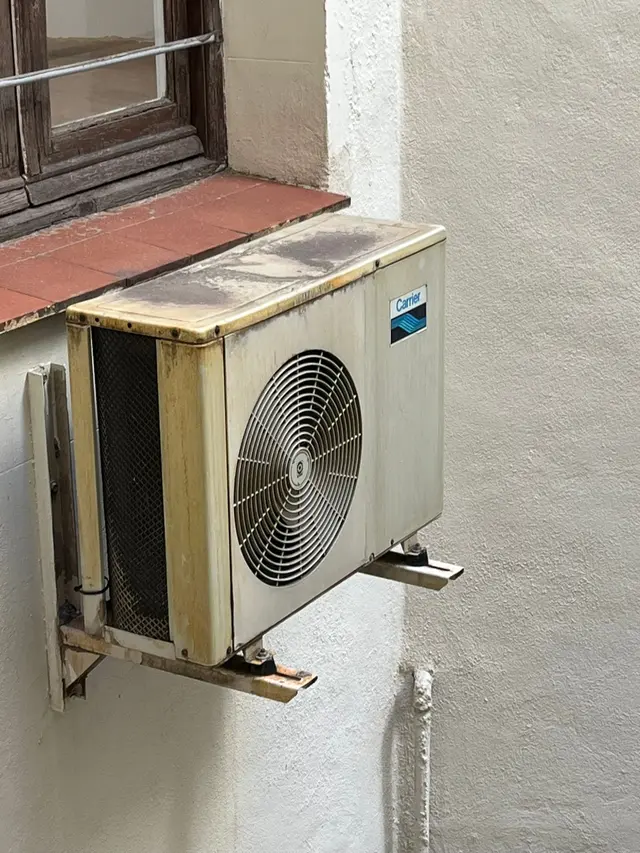
Split carrier
Seen in Madrid centro
Abandoned in place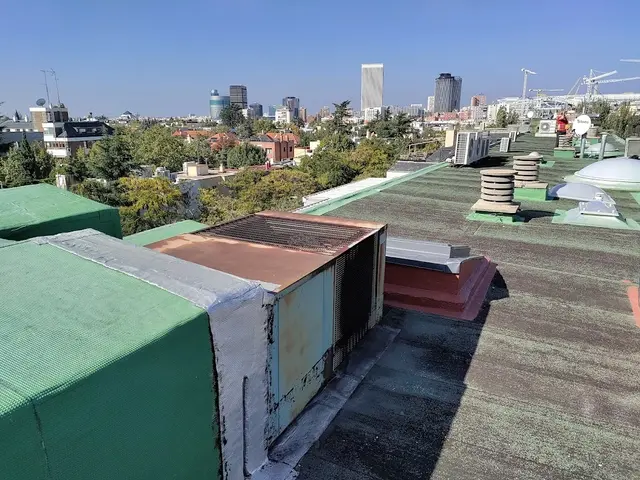
Carrier de azotea
Seen in Madrid · Made inSyracuse, EE. UU.
Abandoned in place«Su placa la delató: Carrier Air Conditioning Company, Syracuse N.Y. Unos setenta veranos a la espalda, oxidándose sobre el tejado.»
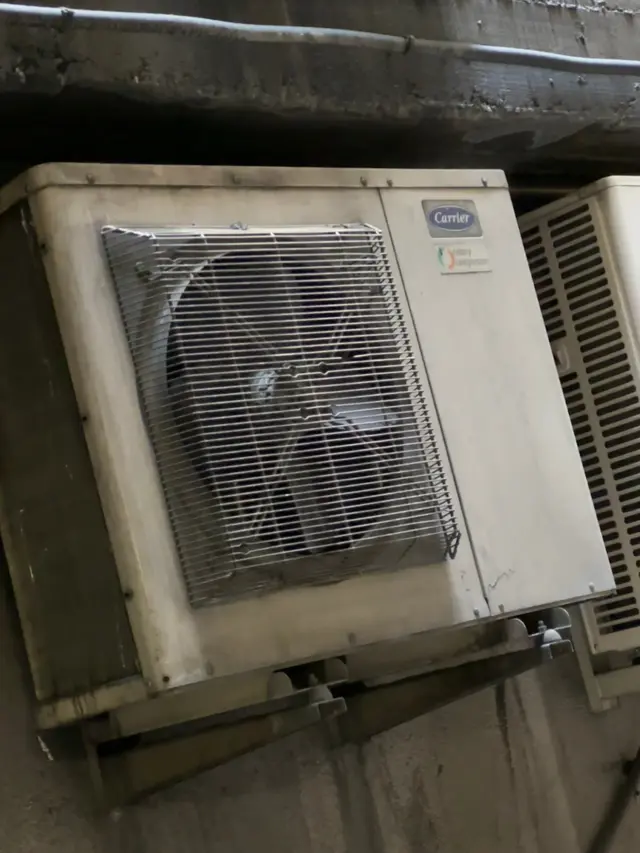
Carrier «rotary compressor» (exterior)
Seen in Spain
Still running«Cubierta de hollín pero con la pegatina de compresor rotativo como una medalla.»
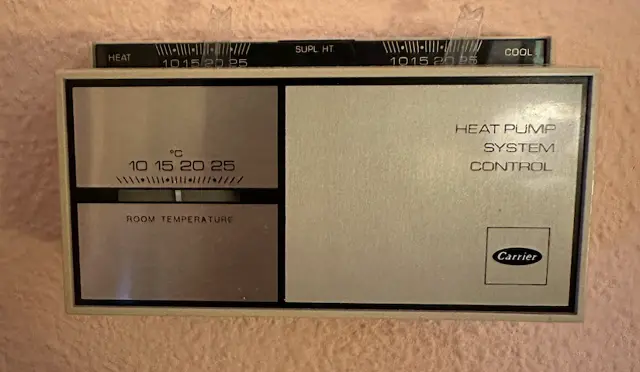
Carrier accessories and parts
Accessories →Remotes, thermostats, components, tools and catalogs from the brand.
Stories and comments
Did you work there, have one at home, know something that is missing here? Tell us: this is a wiki and the history is written by all of us.
Nobody has commented yet. If this machine brings back memories, tell us here.