Maker encyclopedia
Philco 🇺🇸
Estados Unidos · est. 1892 (Philadelphia) · air conditioning since 1938 with York · Philco-Ford 1961-1974 · Philips brand (U.S.) and Electrolux (rest of the world)

Philco started in 1892 as Helios Electric Company, a manufacturer of arc lamps in Philadelphia; in 1906 it became known as Philadelphia Storage Battery Company for its batteries for electric vehicles, and in 1919 it adopted the Philco brand. It entered the radio market in 1928 and by the late 1930s it was already selling more receivers than anyone else, a leadership it maintained for 24 consecutive years with more than 30 million radios, including the wooden “cathedral” models of the thirties. It was a radio, not a refrigerator, that took it into air conditioning.
In 1938 Philco launched its first non‑radio product: the window unit “Cool‑Wave”, manufactured by York Ice Machinery and sold for $395. On January 1 1939 it signed an agreement with York under which the latter would exclusively produce a range of room units for Philco’s worldwide distribution: the Philco‑York CW‑40 and CW‑41, rated at 3,675 BTU/h with a belt‑driven compressor, were sold in Philco‑franchised radio stores and popularized the window‑unit concept. In November 1938 it also purchased Fairbanks‑Morse’s refrigerator division: the logic, according to executive James T. Buckley, was that radios sold at Christmas and cooling sold in summer, “profit all year round.” The first Cool‑Wave was not perfect—it could not endure extreme heat days and lacked an external air intake—but in 1948 York manufactured for Philco the first window unit with a fully sealed compressor, and in 1949 the entire range became sealed: thus Philco earned its reputation as a pioneer of the sealed room unit.
In 1957 production moved from York to Rex Manufacturing, a Philco subsidiary in Connersville (Indiana), which manufactured Philco units for decades: the long “Noiseless” series (1958-1971), the portable “Space Mate”, the “Husky” and “Super Power II” of the seventies, and the high‑capacity “Multi‑Room”. The 1968 redesign introduced vinyl front panels imitating wood that define Philco’s aesthetic of the furniture era. On December 11, 1961 Ford bought the company —which also sold televisions such as the futuristic 1958 Predicta and computers— and in 1966 renamed it Philco‑Ford, a name displayed on the units from 1969‑1972.
Ford sold the non‑automotive business to GTE Sylvania in 1974; GTE transferred Philco International to White Consolidated Industries in 1977 and the U.S. brand to North American Philips in 1981, leaving Philco in the hands of Philips in North America and Electrolux (via WCI) in the rest of the world, with Brazil as a major market. In Argentina it was manufactured under license by the Newsan group since 2004, including air conditioners made in Ushuaia, and the brand was purchased in 2017. For the enthusiast, a 1939 Philco‑York is one of the oldest and most sought‑after window‑unit pieces; a wood‑grain imitation Philco‑Ford, the epitome of the seventies.
In Spain
Philco, the Philadelphia brand that Ford bought in 1961, had a full range of appliances in 1960s Spain, including air conditioning. A 1966 advertisement presents it as a brand of “televisions, refrigerators, air conditioning,” and another from May 1967, published in *Selecciones del Reader's Digest*, devotes an entire page to the air conditioners: “Technical marvels. Air conditioners imported from the U.S.A. Famous worldwide for their quality.” It depicts four units—three window models of different sizes and a large console with two grilles—and argues that “Philco’s technical marvels are the natural consequence of Philco’s deep and extensive experience, achieved through its relentless collaboration in space research,” with a significant commercial claim: the units “enjoy a unique, unaltered price throughout Spain.” It closes with “Buy quality, buy Philco” and the product line list: “automatic washing machines, radios, air conditioners, televisions, turntables, hi‑fi, refrigerators.”
Like Kelvinator, Philco did not manufacture air conditioners in Spain: it imported them and sold them through the network of its other appliances, using the national fixed price as an argument against store bargaining. The brand had been represented in Barcelona since the 1930s by Anglo-Española de Electricidad for radios, although we have not been able to verify who imported the conditioners of the 60s.
A veteran technician cited it in 2009 among the disappeared brands he had dismantled (National, Edesa, Mepamsa, President, Philco, Electrolux, Westinghouse), which confirms that Philco units were installed in quantity. Philco is today a licensed brand of Electrolux in Latin America and has not returned to the Spanish market.
Three ads on todocoleccion: “Advertising 1966: Philco televisions, refrigerators, air conditioning”; “Advertising 1967. Philco ad. Air conditioners” (the May 1967 Selections page with the headline “Technical marvels”, the four devices drawn, the mention “imported from the USA” and the “single unalterable price throughout Spain”); and “Philco air conditioner ad, 60s advertising”. The mention in the 2009 forum comes from the thread about Hitachi on elaireacondicionado.com, and the historical representation of Philco by Anglo‑Española de Electricidad is listed in Radiomuseum.
The 1967 advertisement is also a source for the range: the four devices depicted (three window units of increasing size, with controls on the left and horizontal slat grilles, and a large console with two upper grilles for premises) match the American Philco-Ford line of those years, and the text emphasizes silence twice (“silent conditioners, high performance and maximum service safety”), the argument with which imports were differentiated from domestic devices of the time. The “single unchangeable price throughout Spain” is, for its part, one of the first mentions of a national fixed price in the sector’s advertising, and it suggests a centralized distribution network; the importing company that supported it in 1966‑67 remains to be identified.
Pending verification
Exact year when Rex Manufacturing became a Philco subsidiary (sources say “after the war”) and who manufactured Philco appliances in the United States after 1977.
History machine-translated from Spanish. Can you improve it? Write to us. hola@frostalgia.com
Philco sightings
See all →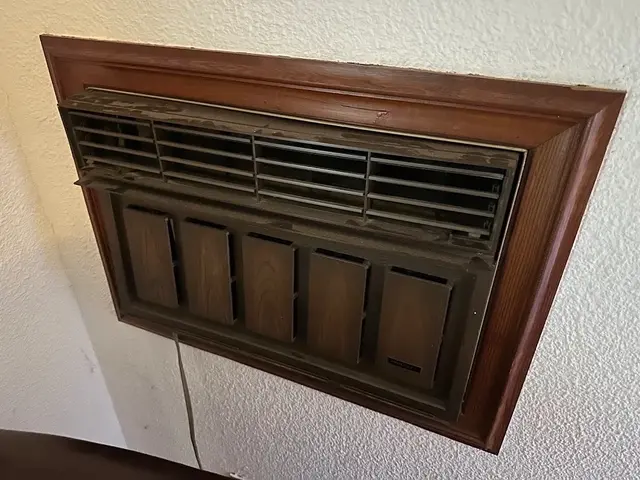
Stories and comments
Did you work there, have one at home, know something that is missing here? Tell us: this is a wiki and the history is written by all of us.
Nobody has commented yet. If this machine brings back memories, tell us here.